













































Platform & DevOps
Reconstructing why a pipeline or config changed six months ago
Search across repos, Jira history and runbooks in one query, with sources attached
Rovo is Atlassian's AI layer for search, chat and agents and if you're on a paid Jira, Confluence or JSM Cloud plan, you're likely already paying for it. Here's what it actually does, where it breaks down, and how to switch it on properly.
Every engineering org we work with has the same quiet tax: a decision was made, written down, and then lost. It's in a Confluence page nobody linked, a Jira comment from March, a Figma file, a Teams thread, or a Loom someone recorded once. The knowledge exists. Finding it costs a week.
That gap is exactly what Atlassian built Rovo for. And unlike most enterprise AI, it isn't a separate product you have to justify to procurement — Rovo is included in Standard, Premium and Enterprise Cloud plans of Jira, Confluence and Jira Service Management, as well as the Teamwork Collection. If you're on one of those plans, this is a switch to configure, not a purchase to approve.
This guide covers what Rovo does, the four capabilities that matter, what it looks like for a DevSecOps toolchain specifically, and a realistic rollout plan.
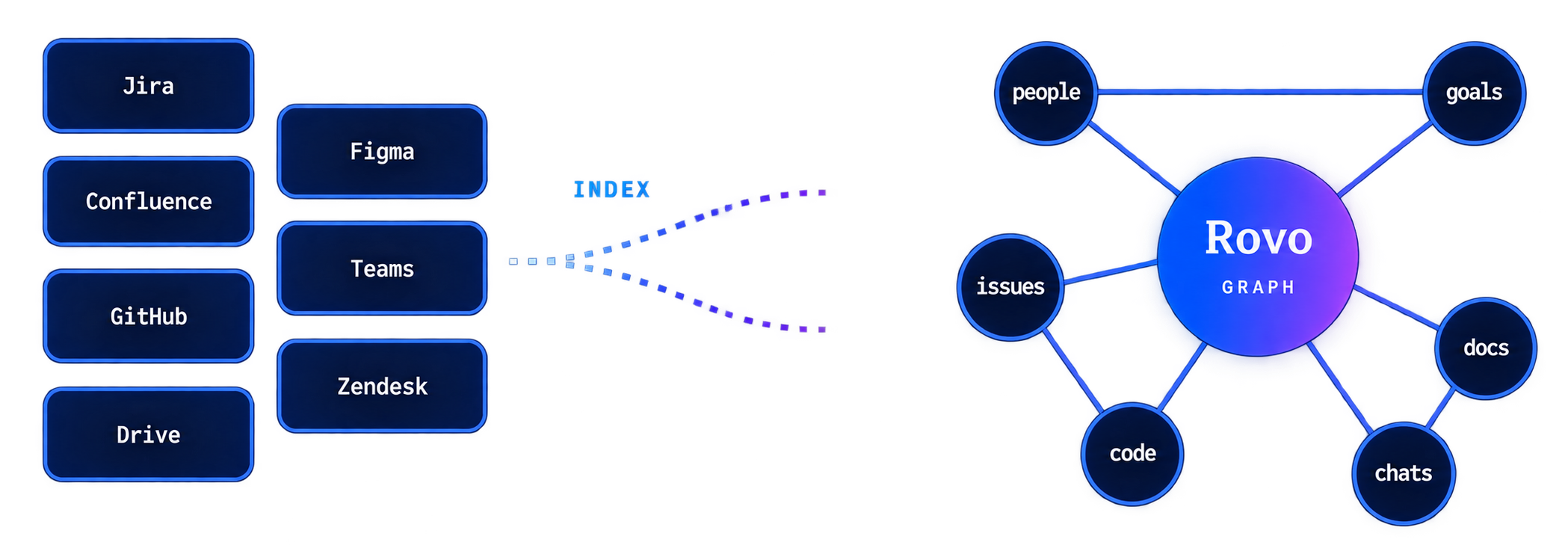
Most AI assistants read one document at a time. Rovo sits on Atlassian's Teamwork Graph — a live map of how your people, projects, goals, code and documents relate to each other. That relationship layer is the whole difference. Asking "why did we deprioritise the payments migration?" only works if the system knows that a Jira epic, an OKR, three Confluence pages and a Slack-adjacent conversation are all the same story.
Rovo indexes Atlassian data first, then extends outward through connectors into the SaaS tools your teams actually live in. Atlassian reports that users are 60% more successful with Rovo Search than leading open-source enterprise search apps — largely because ranking by relationship beats ranking by keyword.
The value isn't the model. It's that the model can see how your work is connected — and respects who's allowed to see what.
Rovo isn't a single feature. It's a stack, and each layer serves a different maturity level of adoption.
Each layer depends on the one below it. Skipping Search and starting with Agents is the most common failed rollout we're asked to rescue.
Federated search across Atlassian apps and connected SaaS tools. Smart Answers respond in natural language with sources; Knowledge Cards surface the who, what and why behind a project directly in results.
LAYER 02Conversational access to the same context — plus actions. Create Jira tickets, draft updates, define internal jargon inline, or run Deep Research to produce a fully cited report across your apps and the web.
LAYER 03Context-aware teammates that own repetitive work. Software teams use them for backlog hygiene and release notes; IT Ops for alert triage, root cause analysis and post-incident reviews.
LAYER 04A no-code workspace to build your own agents, automations and Forge apps from a prompt — where a generic assistant becomes something shaped around how your organisation actually works.
Rovo Dev brings the same context into the command line, and Rovo is reachable through MCP servers, a Chrome extension, desktop and mobile apps — so it isn't locked inside a browser tab.
Rovo's answers are only as good as its index. Connectors extend that index beyond Atlassian into the systems where the rest of the evidence lives — and for a DevSecOps organisation, the source-control and ticketing connectors are the ones that change the quality of answers most.
GitHub · GitLab · Azure DevOps
Drive · SharePoint · OneDrive
Figma · Miro · Lucid · Loom
Gmail · Outlook · MS Teams
Zendesk · Compass
Docusign · Smartsheet
A representative view of Rovo's connector catalogue. Atlassian keeps adding to it; check the connectors page for the current list.
Generic Rovo content stops at “it summarises your Confluence pages.” For teams running a real DevSecOps toolchain, the interesting use cases sit at the seams between tools — exactly where context normally dies.
Reconstructing why a pipeline or config changed six months ago
Search across repos, Jira history and runbooks in one query, with sources attached
Chasing owners for scanner findings and mapping them to real work items
Agents that correlate findings to services and open triaged Jira issues
Repeat tickets that were answered in a doc nobody found
Smart Answers deflect at the portal; agents draft the post-incident review
Assembling the same status narrative every sprint
Agents generate release notes and roadmap updates from live work data
Weeks of asking colleagues what the acronyms mean
Inline definitions and Chat-guided onboarding from day one
Atlassian's published customer outcomes, across very different industries and team shapes.
of wasted engineering time redirected toward critical innovation
acceleration in reporting using Rovo agents
hours saved every week on repetitive support questions
less time spent writing quarterly roadmaps
hours saved per year onboarding new hires
meetings reclaimed in the first five months
Probably. Rovo is available to customers on a Standard, Premium or Enterprise Cloud plan of Jira, Confluence or Jira Service Management, and with the Teamwork Collection. Atlassian has noted that some eligible plans are still completing rollout, so availability can lag slightly behind entitlement.
If you're on Premium or Enterprise today, the AI capability is already in the contract. The only real cost left is the work of connecting your tools, cleaning your spaces, and teaching teams to use it — which is where most of the value gets won or lost.
The failure mode we see most often: an admin enables everything, announces it in a company-wide message, and three weeks later usage is at 4%. Rovo rewards sequencing, because each layer builds the data quality the next one needs.
Entitlement audit, permissions review, space cleanup
Connectors for code, docs and support; Search to pilot team
Two or three agents on measurable jobs; baseline the metrics
Studio agents, enablement sessions, governance model
The Preflex Rovo adoption path. Phase gates matter more than speed; agents trained on messy data produce confidently wrong answers.
Two things determine whether this succeeds, and neither is technical: permission hygiene (Rovo will faithfully surface anything a user is already allowed to see — including the salary spreadsheet in an over-shared space), and a named owner for AI enablement. Pick both before day one.
Rovo isn't a chatbot bolted onto Jira. It's a context layer that only works as well as the data and permissions underneath it which is why the organisations getting 40 reporting speed aren't the ones with the biggest budgets, they're the ones that did the unglamorous groundwork first.
If you're on an eligible Atlassian Cloud plan, the licence is already yours. The question is whether anyone in your organisation owns making it useful.
As an Atlassian Solution Partner, Preflex Solutions helps enterprise teams across India and beyond turn Atlassian entitlements into working systems — not shelfware. Our Rovo engagement covers: